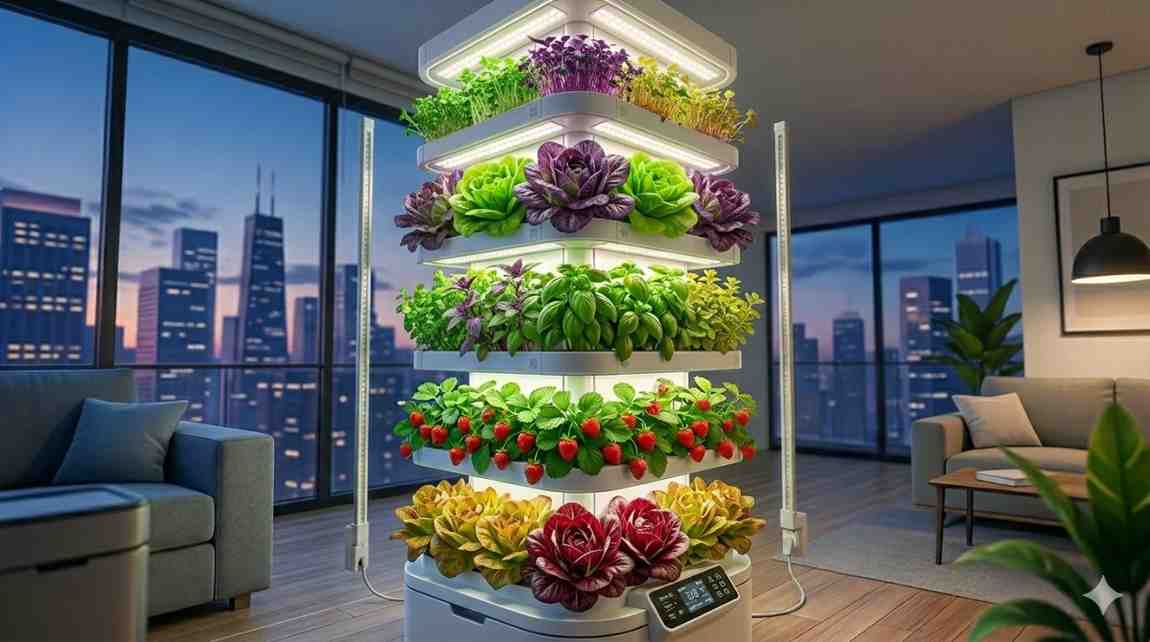
Imagine walking into your kitchen and harvesting a crisp, vibrant head of butterhead lettuce or a handful of spicy arugula—not from a grocery bag, but from a sleek, glowing tower in the corner of your room. For many urban dwellers and modern homesteaders, the dream of self-sufficiency often hits a brick wall: space. Traditional gardening requires horizontal real estate that most of us simply don’t have.
This is where vertical hydroponics system design changes the game. By stacking growing layers upward rather than outward, you can increase your food production by up to 10 times per square foot compared to traditional soil farming. But designing a system that actually works—one that doesn’t leak, clog, or starve your plants of oxygen—requires a blend of engineering, biology, and a bit of art.
In this deep dive, we’ll explore the intricate world of vertical hydroponic architecture, from the physics of nutrient delivery to the selection of the perfect LED spectrum. Whether you’re a DIY hobbyist or looking to scale a commercial venture, this guide is your blueprint for success.
Why Vertical Hydroponics? The Convergence of Efficiency and Sustainability
Table of Contents
ToggleBefore we pick up a drill or buy a pump, we need to understand the “why.” Vertical hydroponics isn’t just a trend; it’s a response to the global need for more efficient food systems.
The Space-Saving Revolution
The primary driver for vertical hydroponics system design is the maximization of “cubic” space. In a standard 4×8 foot garden plot, you are limited by the ground area. In a vertical setup, that same 32 square feet can be extended upward, potentially offering hundreds of planting sites.
Water Conservation and Nutrient Control
Hydroponic systems use up to 90% less water than soil-based agriculture. In a vertical design, water is often recirculated. Gravity becomes your best friend, allowing a single pump to lift water to the top of a column, where it then trickles down, feeding every plant in its path before returning to a central reservoir.
Core Principles of Vertical Hydroponics System Design
Designing a system that survives beyond the first week requires a focus on four pillars: Structure, Hydraulics, Aeration, and Accessibility.
Structure and Load Bearing
Water is heavy. A 50-gallon reservoir weighs roughly 417 lbs. When you add the weight of PVC pipes, grow media, and the plants themselves, your vertical structure needs to be incredibly stable.
Tip: If you are building on a balcony, ensure the floor can handle the concentrated point load of a vertical tower.
Hydraulics: The Science of Flow
In vertical systems, the “Head Height” is your most important metric. This is the vertical distance the pump must push the water.
Design Note: If your tower is 6 feet tall, your pump must have a “Max Head” rating of at least 8–10 feet to ensure consistent flow at the top.
Aeration and Oxygenation
Roots need oxygen just as much as they need water. If roots are constantly submerged in stagnant water, they will succumb to Pythium (root rot).
Solution: Vertical designs like “ZipGrow” style towers or “NFT” (Nutrient Film Technique) pipes ensure that while the roots are moistened, they are also exposed to the air within the column.
Popular Vertical Hydroponic Configurations
There is no “one-size-fits-all” in vertical hydroponics system design. The right choice depends on your crop, your budget, and your environment.
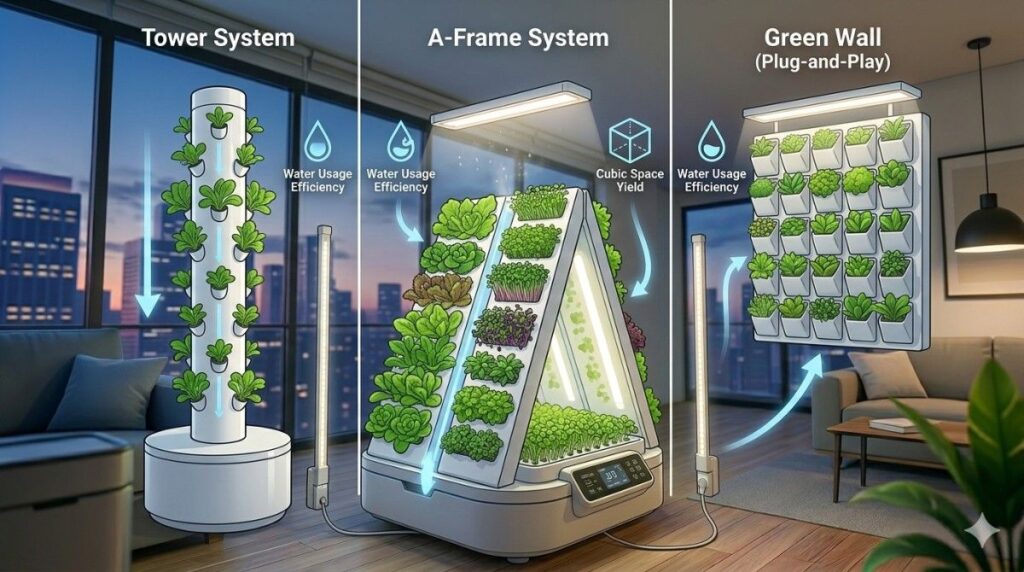
A-Frame Systems
Commonly used for strawberries and greens, the A-Frame utilizes inclined PVC pipes on both sides of a triangular support.
Pros: Excellent light distribution; very stable.
Cons: Takes up more floor space than a single tower.
Vertical Towers (The Column Design)
The most iconic vertical design. Plants grow out of the sides of a central PVC or food-grade plastic column.
Aeroponic Towers: Water is sprayed as a fine mist directly onto the dangling roots inside the tower.
Trickle Towers: Water flows over a medium (like coconut coir or expanded clay) inside the tower.
Green Walls (Plug-and-Play)
Often used for herbs and ornamental plants, these involve pockets or felt mats attached to a wall. While aesthetically pleasing, they can be harder to maintain for heavy-feeding crops like tomatoes.
Selecting the Right Growing Medium
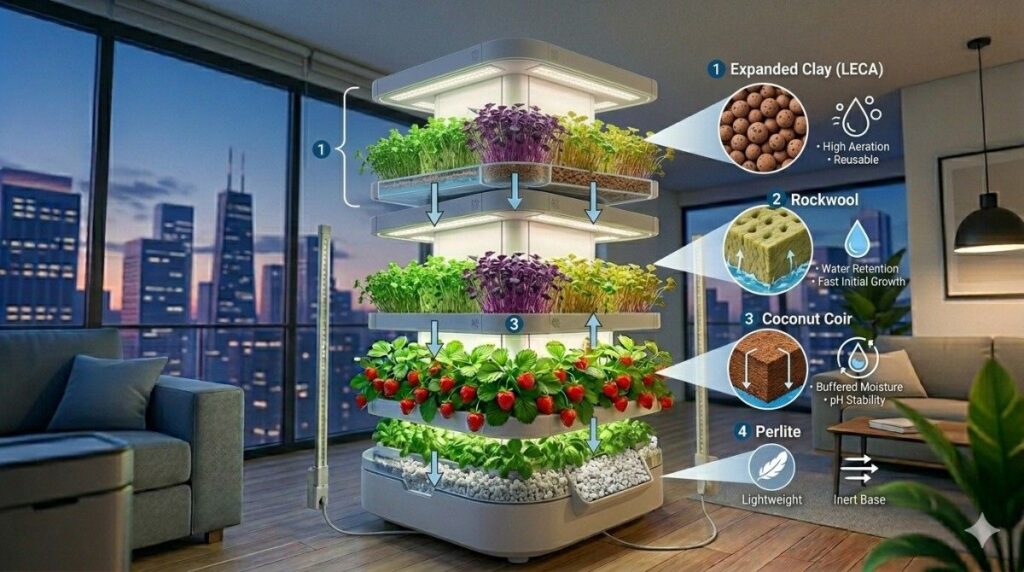
In vertical hydroponics system design, the medium must be lightweight and provide excellent drainage. You don’t want a medium that stays “soggy,” as gravity will naturally pull water downward, potentially drowning the plants at the bottom of the system while the top ones dry out.
| Medium | Pros | Cons |
| Expanded Clay (LECA) | Great aeration, reusable. | Heavy; can be noisy in towers. |
| Rockwool | Excellent water retention for starts. | Not biodegradable; pH can drift. |
| Coconut Coir | Organic origin; holds moisture well. | Can clog fine sprayers in aeroponics. |
| Perlite | Extremely lightweight. | Tends to float; can get messy. |
Lighting: The Engine of Growth
If you are designing an indoor vertical system, lighting is your biggest variable cost and your most critical success factor.
The Inverse Square Law
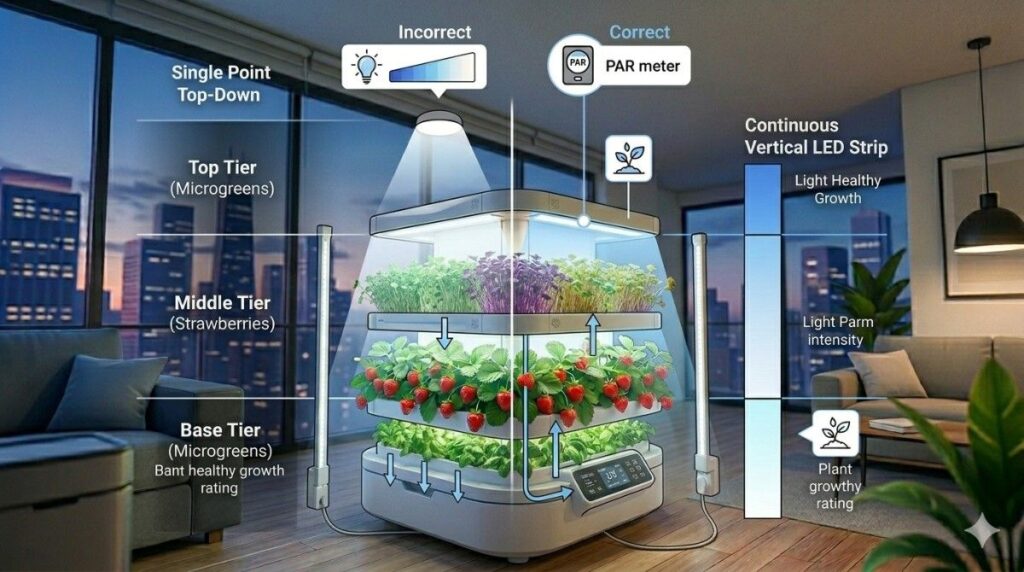
In vertical gardening, plants at the top of a tower might be closer to the light source than those at the bottom. This creates a “light gradient” that can lead to uneven growth.
The Math: Light intensity decreases according to the Inverse Square Law.
Design Fix: Use vertical LED strips that run the entire length of the tower to ensure the bottom plant gets the same “PAR” (Photosynthetically Active Radiation) as the top one.
Spectrum Matters
For leafy greens, a “Blue” heavy spectrum (around 5000K–6500K) encourages compact, vegetative growth. For flowering plants like strawberries or peppers, you’ll need “Red” spectrum additions (around 2700K–3000K).
Nutrient Management and Water Chemistry
The “hydro” in hydroponics means water is the delivery vehicle for all life. In a vertical system, the nutrient solution circulates constantly, meaning any imbalance is felt by every plant simultaneously.
pH and EC: The Vital Signs
pH: Most hydroponic plants thrive in a slightly acidic range of 5.5 to 6.5. If the pH drifts too high (alkaline) or too low (acidic), “nutrient lockout” occurs, where the plant can no longer absorb specific elements.
EC (Electrical Conductivity): This measures the concentration of salts (nutrients) in your water.
Lettuce/Herbs: Low EC (1.0–1.6)
Tomatoes/Cucumbers: High EC (2.0–3.5)
The Role of Oxygen
As water falls through a vertical tower, it naturally picks up oxygen—a process called “passive aeration.” This is a huge advantage of vertical hydroponics system design over deep water culture (DWC).
Step-by-Step: Designing Your First DIY Vertical Tower
If you’re ready to get your hands dirty (metaphorically), here is a simplified workflow for a 5-foot PVC Vertical Tower.
Materials Needed:
4″ Food-Grade PVC Pipe (The Tower)
2″ PVC Pipe (For the internal “shower” distribution)
Submersible Pump (800 GPH with 8ft head height)
20-Gallon Reservoir (Tote with lid)
Net Pots and Grow Medium
Heat Gun (To mold the PVC pockets)
The Process:
Mark Your Pockets: Space your planting sites roughly 8–10 inches apart, staggered in a “zigzag” pattern around the 4″ pipe.
Heat and Mold: Use a heat gun to soften the PVC at the marks, then push a glass bottle inward to create a “pocket” where the net pot will sit.
The Irrigation Core: Drill small holes every 2 inches along the length of your 2″ pipe. Place this inside the 4″ pipe. This ensures water is distributed evenly to all levels, not just the very top.
Assembly: Mount the tower securely over the reservoir lid. Connect the pump to the internal 2″ pipe.
Test Run: Run the system with plain water first to check for leaks and ensure every pocket is receiving moisture.
Common Pitfalls in Vertical Hydroponics System Design
Even the best-laid plans can go awry. Here’s what to watch out for:
Algae Growth: If light hits your nutrient solution, algae will bloom. Algae compete for nutrients and can clog your pump. Solution: Use opaque (non-see-through) pipes and reservoirs.
Tip Burn: This often happens in vertical towers where there isn’t enough airflow. It’s caused by a localized calcium deficiency because the plant isn’t transpiring enough. Solution: Add a small oscillating fan to move air around the plants.
Pump Failure: If your pump stops, a vertical system can dry out in hours because there is no soil to hold moisture. Solution: Invest in a high-quality pump and consider a battery backup or a moisture sensor alarm.
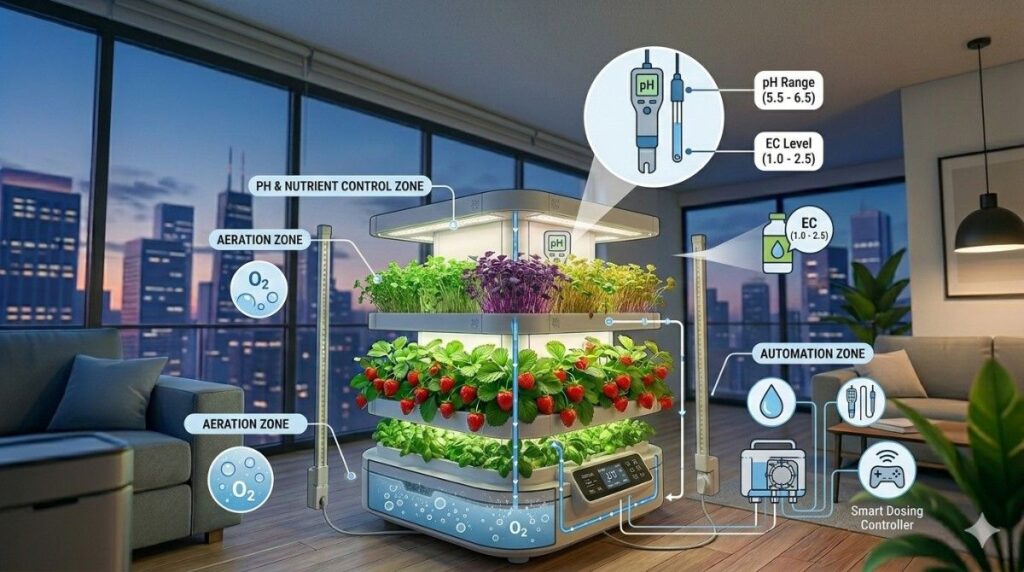
Automation: The Future of Vertical Design
The integration of IoT (Internet of Things) into vertical hydroponics system design is making “set it and forget it” gardening a reality.
Sensors and Dosers
Modern systems use sensors to monitor pH and EC in real-time. When the levels dip, peristaltic pumps automatically “dose” the reservoir with concentrated nutrients or “pH Down” solution.
Smart Lighting Cycles
Using apps like Home Assistant or simple smart plugs, you can mimic the natural rising and setting of the sun, including “ramp up” periods that reduce stress on the plants.
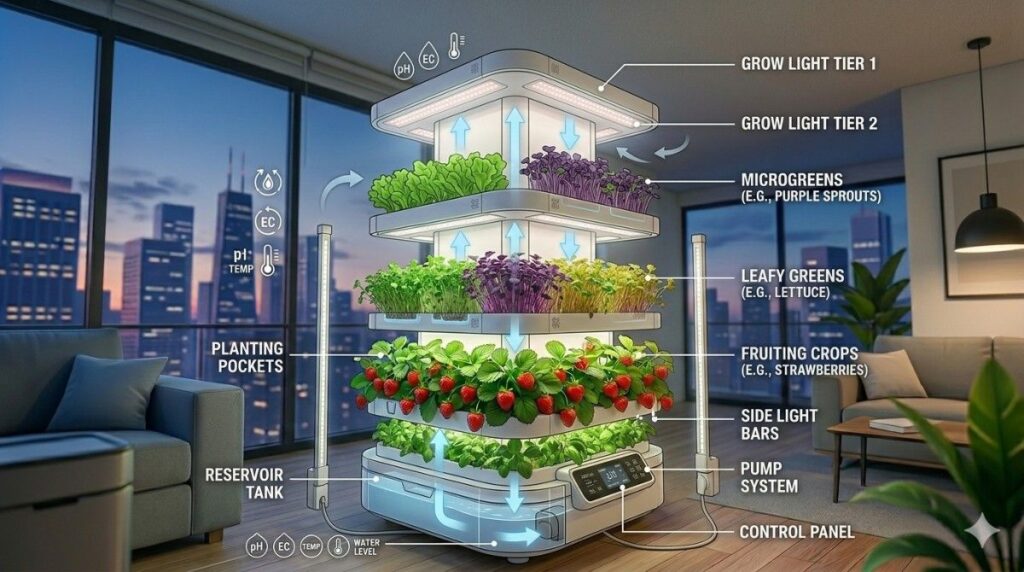
Elevate Your Gardening Game!
Vertical hydroponics system design is more than just a space-saving hack; it is a sophisticated method of ultra-efficient food production. By understanding the balance between gravity, light, and nutrient chemistry, you can transform a sterile corner of your home into a lush, productive ecosystem.
The journey from a few PVC pipes to a flourishing vertical farm is one of constant learning and refinement. Start small, master the chemistry of your water, and don’t be afraid to experiment with your design. The future of food is looking up—literally.
Are you ready to build your own vertical oasis? Let us know in the comments which design you’re leaning toward, or share your DIY success stories!