Introduction: Why Water Temperature Is the Hidden Key to Hydroponic Success
Imagine spending weeks carefully balancing your nutrient solution, dialing in your lighting schedule, and monitoring pH levels — only to watch your plants grow slowly, look pale, and underperform. Frustrating, right? Many hydroponic growers obsess over nutrients and light while completely overlooking one of the most critical variables of all: water temperature.
If your reservoir water is too cold, your plants’ roots struggle to absorb nutrients efficiently, growth stalls, and your crops become vulnerable to root rot and disease. If it’s too warm, dissolved oxygen levels plummet and harmful pathogens thrive. This is exactly where a quality hydroponic water heater becomes one of the most important investments you’ll make in your grow room.
In this comprehensive guide, you’ll learn everything you need to know about hydroponic water heaters — from why root zone temperature matters so deeply, to choosing the right heater for your system, to maintaining optimal temperatures year-round. Whether you’re growing lettuce in a small DWC bucket or running a large commercial NFT system, this guide will give you the knowledge to unlock your plants’ full genetic potential.
Why Water Temperature Matters in Hydroponics
The Science of Root Zone Temperature
Plant roots are highly sensitive to temperature. Unlike soil growers who benefit from the natural thermal mass of the earth, hydroponic growers have full control — and full responsibility — for the temperature environment their roots live in. The root zone is where all nutrient uptake, oxygen absorption, and water transport begins, making it arguably the most important microenvironment in your entire system.
When water temperature drops below the optimal range, the metabolic processes in root cells slow dramatically. Enzymes responsible for nutrient absorption become less efficient, and the plant must expend more energy just to maintain basic functions. This is why cold water in a reservoir doesn’t just slow growth — it can effectively starve your plants even when the nutrient solution is perfectly balanced.
Conversely, warm water holds significantly less dissolved oxygen (DO). At 68°F (20°C), water holds roughly 9.1 mg/L of dissolved oxygen. At 77°F (25°C), that drops to about 8.2 mg/L. At 86°F (30°C), it falls further to around 7.5 mg/L. This reduction in oxygen availability starves roots and creates anaerobic conditions that favor root rot-causing pathogens like Pythium.
The Optimal Temperature Range for Hydroponic Nutrient Solutions
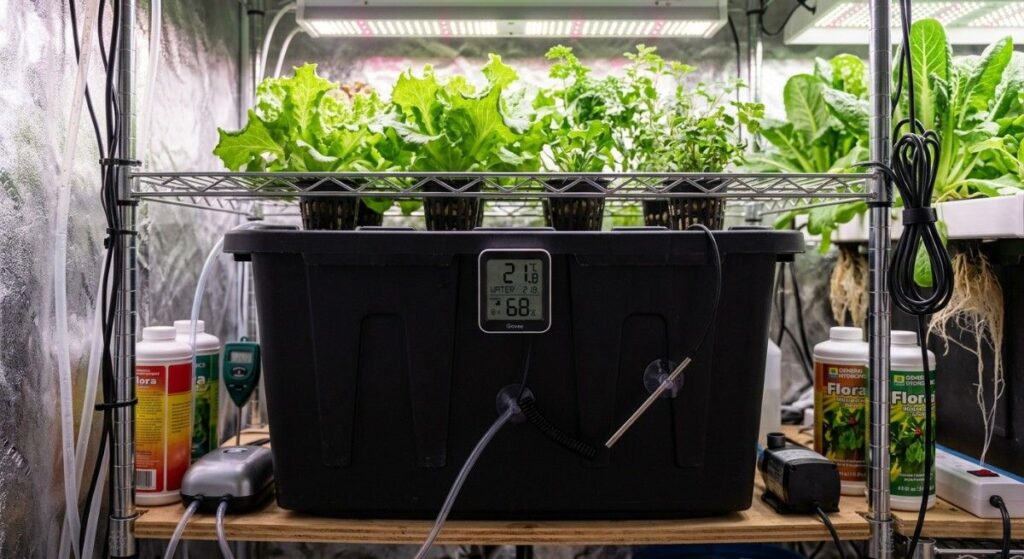
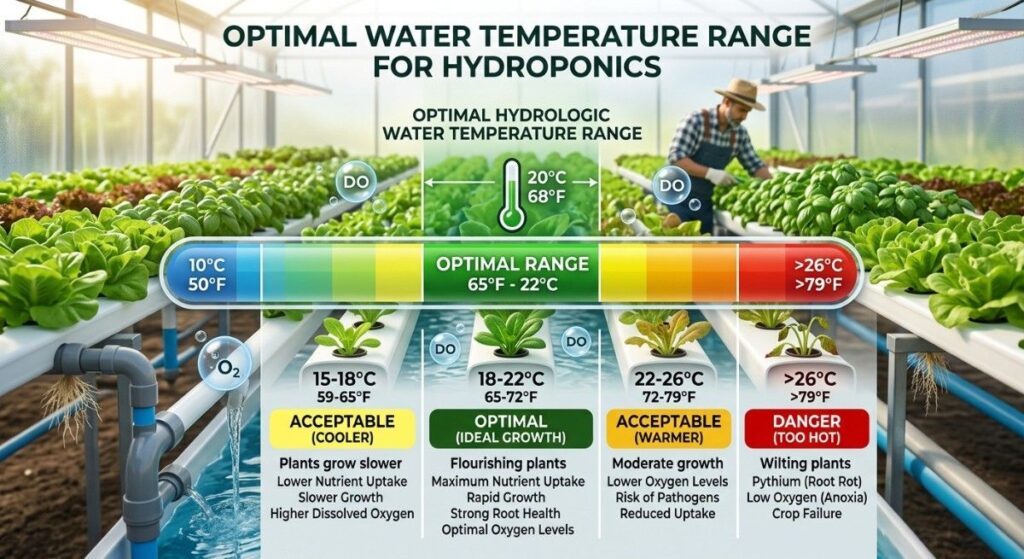
The sweet spot for most hydroponic crops is a nutrient solution temperature between 65°F and 72°F (18°C to 22°C). Within this range:
- Roots absorb macro and micronutrients most efficiently
- Dissolved oxygen levels remain high enough to prevent anaerobic conditions
- Beneficial microbes (if used) thrive without competing with pathogens
- Plant metabolic rate is optimized for growth
Warm-season crops like tomatoes and peppers can tolerate the higher end of this range — up to 75°F (24°C) — while cool-season crops like lettuce, spinach, and herbs perform best at the lower end, between 65°F and 68°F (18°C to 20°C).
The Hidden Cost of Cold Reservoirs
In colder climates or during winter months, unheated reservoir water can easily drop below 60°F (15°C). At this temperature, root activity slows substantially, nutrient uptake becomes highly inefficient, and plants can enter a kind of metabolic torpor. Many growers in northern regions report dramatically slower growth cycles in winter — not because of light deficiency, but because of cold reservoir water. A dedicated hydroponic water heater is the most direct solution to this problem.
Types of Hydroponic Water Heaters
Submersible Aquarium-Style Heaters
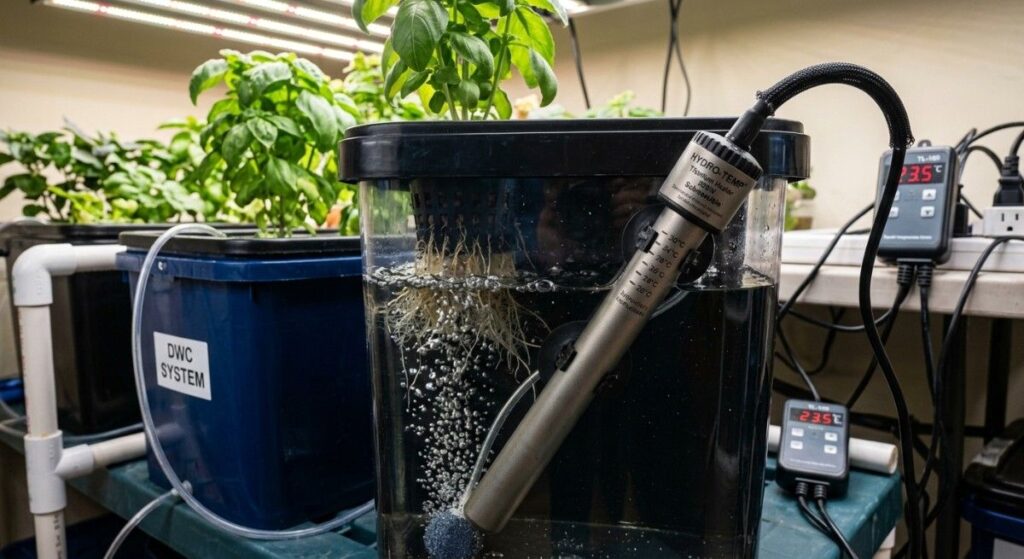
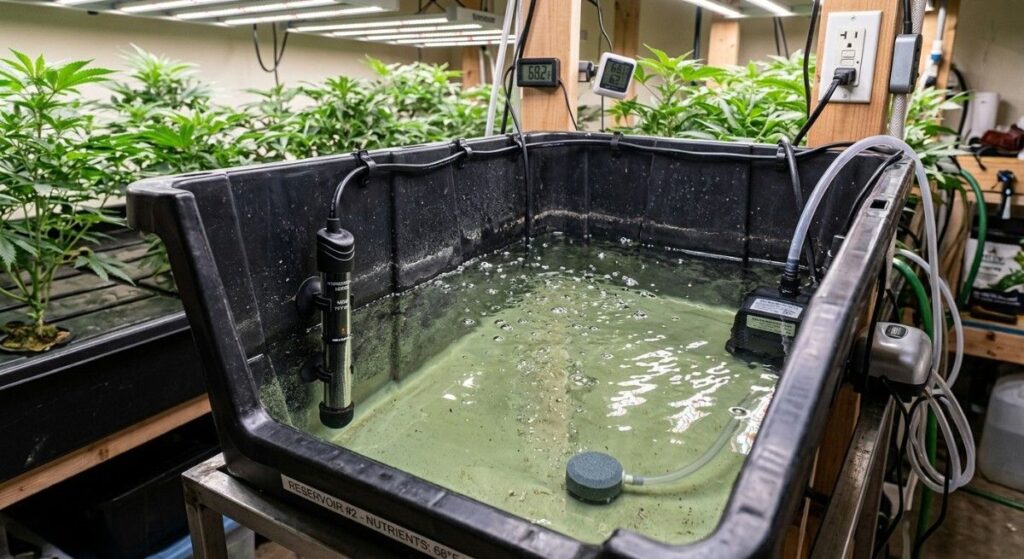
The most common and affordable option for small to mid-sized hydroponic systems is the submersible aquarium heater. These devices — originally designed for fish tanks — work equally well in nutrient reservoirs. They consist of a glass or titanium tube housing a heating element and thermostat, which you simply clip or suction-cup to the inside of your reservoir.
Pros:
- Low cost (typically $15–$60)
- Easy to install — fully submersible, no plumbing required
- Accurate thermostats in quality models
- Available in a wide range of wattages (50W to 300W)
Cons:
- Glass models can shatter if accidentally exposed when the reservoir runs low
- Lower-end models can have inaccurate temperature control
- Limited to smaller reservoir volumes
Best for: DWC (Deep Water Culture), Kratky method, small ebb-and-flow systems, and reservoirs up to 50 gallons.
Pro tip: Titanium-bodied aquarium heaters are strongly recommended for hydroponic use. Unlike glass heaters, titanium won’t leach harmful materials into your nutrient solution and is far more durable.
Inline Water Heaters
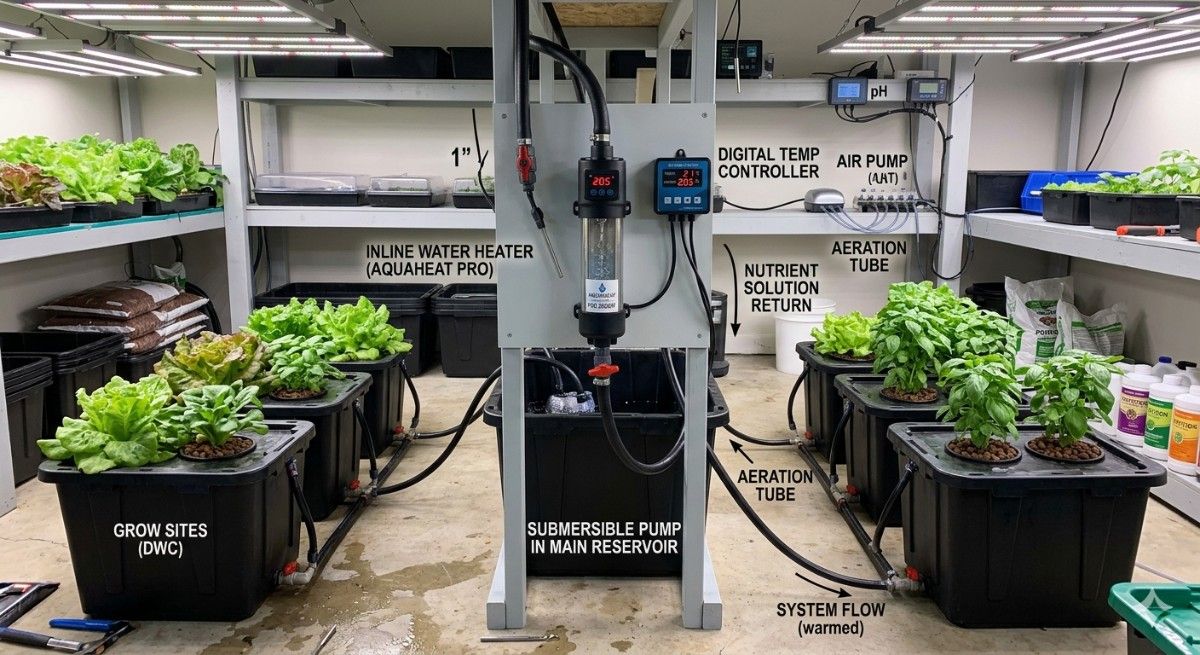
For larger systems or those with external reservoirs feeding multiple grow beds, an inline water heater is an excellent choice. These units mount directly onto the water lines of your recirculating system. Water flows through the heater as it’s pumped through your system, maintaining a consistent temperature without any components sitting inside the reservoir.
Pros:
- No equipment inside the reservoir (cleaner, easier to maintain)
- Suitable for large-scale systems
- Consistent heating across high-volume water flows
- Some models integrate with automation systems
Cons:
- Higher upfront cost ($80–$400+)
- Requires plumbing connections
- Installation is more complex
Best for: NFT (Nutrient Film Technique) systems, large ebb-and-flow setups, commercial hydroponic operations, and systems with external reservoirs.
Titanium Heating Rods
Titanium heating rods are a step above standard aquarium heaters in terms of durability and chemical resistance. Because titanium is inert in nutrient solutions, there’s zero risk of contamination. These rods are controlled by an external temperature controller (thermostat), giving you precise temperature management.
Pros:
- Extremely durable and corrosion-resistant
- Completely inert — won’t affect nutrient solution chemistry
- Very accurate with a quality external controller
- Long lifespan
Cons:
- Requires a separate temperature controller
- Higher cost than basic aquarium heaters
Best for: Growers who want precision and longevity, particularly in systems where nutrient chemistry is critical, such as cannabis cultivation or commercial leafy greens production.
Reservoir Heating Mats and Pads
For very small systems or seedling propagation, silicone heating mats designed for hydroponic use can raise reservoir or tray temperature by wrapping around or sitting beneath the container. These are low-wattage devices best suited for modest temperature lifts in small volumes.
Best for: Propagation trays, small cloner reservoirs, seedling stations.
How to Choose the Right Hydroponic Water Heater
Calculating the Right Wattage
Choosing the correct wattage for your hydroponic water heater is critical. Too little wattage and the heater won’t be able to maintain temperature in cold conditions. Too much, and you risk overheating if the thermostat malfunctions.
A common rule of thumb is 5 watts per gallon of reservoir volume for maintaining temperature, or 10 watts per gallon if you’re trying to raise temperature significantly in a cold environment. For example:
- 10-gallon reservoir: 50–100W heater
- 30-gallon reservoir: 150–300W heater
- 55-gallon reservoir: 275–550W heater
For larger commercial systems, inline heaters rated in kilowatts are standard.
Consider Your Grow Room Ambient Temperature
Your grow room’s ambient temperature dramatically affects how hard your water heater has to work. In a warm grow tent where lights generate significant heat, your reservoir might actually need cooling rather than heating in summer. In a cold basement or garage in winter, a heater becomes essential.
Always measure your ambient room temperature across different seasons before deciding on heater wattage. An under-powered heater struggling in a cold garage is just as problematic as having no heater at all.
Material Matters: Titanium vs. Glass vs. Stainless Steel
As mentioned, titanium is the gold standard for hydroponic applications due to its complete chemical inertness. Stainless steel heaters are also acceptable in most nutrient solutions. Glass heaters, while functional, carry breakage risk and are generally not recommended for professional or permanent setups.
Avoid cheap plastic-coated heaters, as some plastics can leach compounds into your nutrient solution over time, particularly at elevated temperatures.
Thermostat Accuracy and Range
Look for heaters or temperature controllers with an accuracy of ±0.5°C (±1°F) or better. Many budget aquarium heaters have inaccurate thermostats that can drift by several degrees, leading to temperature swings that stress plants. Investing in a heater with a digital thermostat or using a high-quality external temperature controller pays dividends in crop consistency.
Setting Up and Installing Your Hydroponic Water Heater
Placement for Maximum Efficiency
Placement of your submersible heater inside the reservoir significantly affects performance. Follow these best practices:
Position horizontally near the pump outlet. Placing the heater near where your circulation pump draws or returns water ensures heated water is mixed and distributed throughout the reservoir quickly, preventing hot spots near the heater and cold zones elsewhere.
Keep the heater fully submerged at all times. Running a submersible heater partially out of water damages the element and can cause cracking or failure. Always maintain your reservoir level above the heater’s minimum submersion mark.
Avoid placing the heater directly under air stones. Turbulent bubbles directly over the heater can interfere with the thermostat’s temperature reading, causing the heater to cycle incorrectly.
Using an External Temperature Controller
Even mid-range heaters with built-in thermostats benefit from being paired with an external digital temperature controller. These devices use a separate probe to measure actual water temperature and switch the heater on and off via an outlet. This eliminates reliance on the heater’s internal thermostat, which can be unreliable.
Popular options like the Inkbird ITC-306A or Ranco ETC-111000 provide accurate, reliable temperature control for under $40 and can be used with virtually any submersible or inline heater.
Step-by-Step Installation for a Submersible Heater
- Fill your reservoir to operating level before installing the heater.
- Attach the heater to the reservoir wall using the supplied suction cups or clips, positioned near the bottom and angled horizontally.
- Set the desired temperature on the heater’s dial (or on your external controller).
- Allow the heater to equilibrate for 15–30 minutes before plugging in — this prevents thermal shock to the glass housing.
- Plug in and monitor the water temperature for the first several hours using a calibrated digital thermometer to verify accuracy.
- Adjust as needed based on actual temperature readings versus the set point.
Maintaining Optimal Nutrient Solution Temperature Year-Round
Insulating Your Reservoir
Even with a heater running, a poorly insulated reservoir loses heat rapidly. Insulation reduces the workload on your heater and keeps temperature more stable. Options include:
- Wrapping the reservoir in closed-cell foam insulation
- Using a purpose-built insulated reservoir or cooler
- Storing the reservoir inside a grow tent where ambient temperatures are warmer
- Covering the reservoir lid with reflective material
A well-insulated 30-gallon reservoir can reduce heater energy consumption by 30–50% in cold environments.
Balancing Heating and Cooling Across Seasons
One of the most overlooked aspects of hydroponic water temperature management is that the problem often reverses seasonally. The same grow room that needs a hydroponic water heater in winter may need a water chiller in summer, particularly in warmer climates or when grow lights generate significant heat.
A complete temperature management strategy includes:
- Winter/Cool Season: Submersible or inline heater + insulated reservoir
- Summer/Warm Season: Water chiller or reservoir placed in the coolest part of the room, away from lights
- Year-round: External temperature controller and continuous temperature monitoring
Monitoring Water Temperature
Temperature monitoring should be continuous in any serious hydroponic operation. Options range from simple analog thermometers (read manually) to digital probes with alarms and data logging. For automated systems, pH/EC/temperature combo meters offer integrated monitoring in one device.
Set alert thresholds at 63°F (17°C) on the low end and 75°F (24°C) on the high end for most crops. Any reading outside this range should trigger immediate investigation.
Troubleshooting Common Hydroponic Water Heater Problems
Heater Running Constantly but Temperature Not Reaching Set Point
This typically indicates the heater is underpowered for the reservoir volume or ambient temperature. Solutions include adding a second heater, upgrading to a higher wattage unit, or better insulating the reservoir. Also check that the heater is fully submerged and positioned correctly.
Temperature Overshooting the Set Point
If your water is consistently warmer than the set point, your heater’s internal thermostat may be drifting. Use an external temperature controller to override the internal thermostat and maintain accurate temperature. In the short term, reduce the heater’s set point dial until the actual water temperature matches your target.
Heater Not Turning On
Check the power supply, outlet, and any GFCI protection that may have tripped. If using an external controller, verify the outlet assigned to heating (not cooling) is correctly identified. If the heater itself has failed, glass heaters are best replaced entirely; titanium elements can sometimes be serviced.
White Mineral Deposits on the Heater
In areas with hard water or when nutrients accumulate on the heater surface, mineral buildup reduces heating efficiency and can damage the thermostat. Clean the heater regularly with a dilute citric acid or vinegar solution (unplugged and removed from the reservoir), then rinse thoroughly before reinserting.
Advanced Tips for Professional Hydroponic Temperature Management
Zonal Temperature Control in Large Systems
In commercial operations with multiple reservoirs or growing zones, each zone may require independent temperature management. Inline heaters with modulating valves and centralized monitoring systems allow facility managers to maintain different temperature profiles for different crops or growth stages under one roof.
Root Zone Temperature vs. Air Temperature
A common mistake among newer growers is assuming that maintaining warm air temperature in the grow room is sufficient for root health. Air temperature and water temperature are separate variables. A grow room at 75°F (24°C) can easily have a reservoir sitting at 58°F (14°C) if located on a concrete floor in winter. Always measure both independently.
Using Temperature Differential to Trigger Flowering
Some experienced cannabis and tomato growers deliberately drop night reservoir temperature by 2–4°F as a stressor to trigger and enhance flowering responses. This advanced technique — sometimes called “cool night feeding” — should only be attempted once your baseline temperature management is dialed in perfectly.
The Best Hydroponic Water Heaters on the Market
Without endorsing specific brands, here are the categories of products widely praised by the hydroponic community:
For small home systems (under 20 gallons): Look for titanium-bodied aquarium heaters in the 100–200W range from established aquarium brands, paired with an external digital controller.
For mid-sized systems (20–60 gallons): 300W titanium heaters or dual 200W heaters in large reservoirs, combined with a quality external temperature controller.
For large or commercial systems: Inline water heaters from manufacturers specializing in hydroponics or aquaculture, rated for the specific flow rate of your recirculating pumps.
For propagation: Low-wattage silicone heat mats designed for seedling trays, regulated with a separate plug-in thermostat.
Conclusion: Take Control of Your Root Zone Temperature Today
Your plants are only as productive as the environment you create for their roots. Cold, unheated nutrient solution is one of the most common and easily corrected reasons hydroponic growers fail to achieve the yields their systems are capable of. A well-chosen hydroponic water heater, correctly sized and properly installed, can be transformational — accelerating growth rates, improving nutrient uptake, reducing disease pressure, and ultimately delivering bigger, healthier harvests.
The investment is modest: a quality titanium submersible heater and external temperature controller will typically run $50–$120 for most home systems, a small fraction of what you’ve already invested in lights, nutrients, and equipment. The return, measured in faster growth cycles, higher yields, and fewer crop losses, is substantial.
Start by measuring your current reservoir temperature across different times of day and different seasons. If you find it dropping below 65°F (18°C) at any point, it’s time to add heating. Choose a heater rated for your reservoir volume, insulate your reservoir to reduce heat loss, and monitor continuously with a calibrated thermometer or automated controller.
Your roots will thank you — and your harvest will show it.
Did this guide help you improve your hydroponic setup? Share it with a fellow grower or drop your questions and experience in the comments below. What hydroponic water heater are you currently using, and what temperature do you target for your crops?